The Energy Academy:
On the sector & its societal acceptance
As work on the reformation of the Energy sector in Germany progresses, it has become all the more clear that citizen’s faith in the necessity, achievability and fairness of the changes being made will determine the success of the movement.
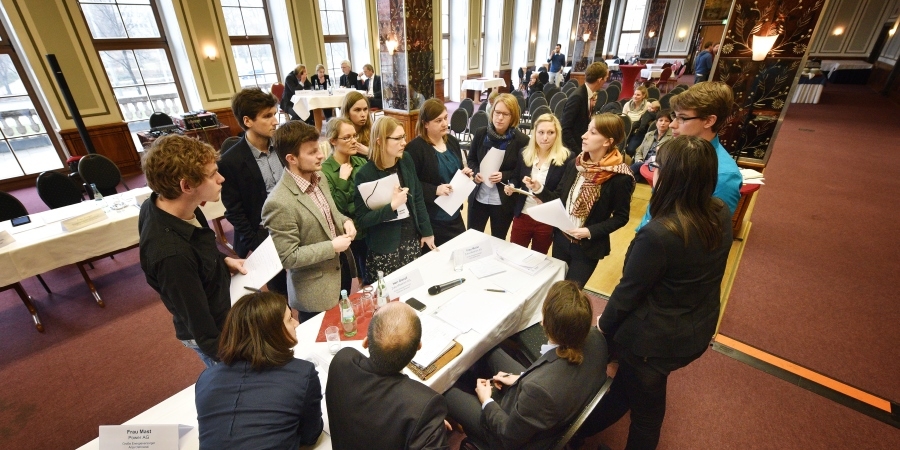
Realistically, it is unlikely that urgent decisions with far-reaching consequences can be implemented against the will of society. However, it is also unrealistic to expect a perfect consensus regarding all the technical and economic details as there will always be limits as to what is achievable. For many conflicts which are emerging in this discussion, there is a lack of applicable rules. How can a dialogue, leading to a reliable compromise, be conducted under these conditions so that the reformation of the energy sector can progress? This is the question which has been the focus of the Academy for the Energy Sector and its acceptance, which has been conducted by the WCGE since 2012, with the support of the innogy Foundation for Energy and Society and in cooperation with the Department of Energy Management and Sustainability at the University of Leipzig. Doctoral and Master students develop their understanding of business ethics principles, enter into exchange with experts from politics, business, academia and civil society and finally, put their learnings to the test in a simulated stakeholder dialogue, where they experience the opportunities and limits of trust-building dialogue processes.
[accordion activeIndex=""]
[item title="Who is the target group?"]
The academy is tailored towards doctoral and Masters students in diverse areas of study, who have an interest in the Energy sector.
[/item]
[item title="Teaser"]
[/item]
[item title="Content & Program"]
The academy makes it possible for future leaders to take a holistic perspective on the complex topics in the Energy sector via the integrated communication of business ethics and energy economics insights. They are introduced to experts from business practice, other participants with diverse backgrounds and skills and each year, they deal with a different, sub-topic. The climax of the event is the simulated stakeholder dialogue, which is a public event whereby the participants take on the role of the respective interest groups, thereby changing their perspective on the issue and experiencing a sustainable learning effect. On the basis of a case study, each participant is expected to represent their position convincingly and to reach a solution which each of the participants in the dialogue can agree to. The Academy lasts for one week and takes place each year in Spring from Sunday to Friday.
[/item]
[item title="Experts and Participants"]
- Experts from Federal politics, the Energy sector, academia and NGOs
- To date, 100 students from throughout Germany
[/item]
[item title="Past Topics"]
- 2012: Expansion of network coverage
- 2014: Supporting investment – Sharing the costs: How can the reformation of the Energy sector be fairly shared?
- 2015: (De-)Central Energy Supply: How can societal participation and security of supply be achieved simultaneously?
- 2016: Big Data as the Key to the Energy Reformation?
- 2017: Elektromobilität als Schlüssel zur Energiewende?
- 2018: (Wie) Lassen sich Klimaschutz und Wettbewerbsfähigkeit vereinbaren?
[/item]
[item title="Information and Contact"]
Henrike Heierberg
Project Manager
Tel. +49(0)3491 / 5079 115
Email
[/item]
[/accordion]